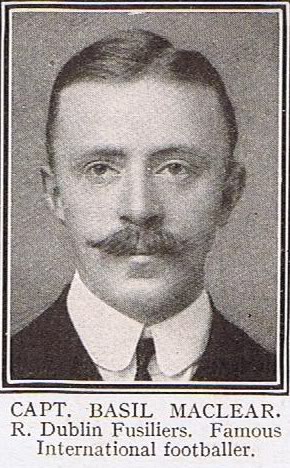
Maclear, Basil
Irish internationals: 11 : 1905 E+ (1t 1c) S+ (1c) W- NZ- ; 1906 E+ (1t 1c) S- W+ (1t) SA- (1t) ; 1907 E+ S- W-
Basil Maclear was born on 7 April 1881, in Portsmouth
Played as a Centre/wing for: Bedford School, RMC Sandhurst, Cork County, Monkstown, Blackheath, Bedford, Cork Constitution, Munster
Profession: The Army (Royal Dublin Fusiliers). He graduated from the Royal Military College, Sandhurst, in 1900, having gained the Sword of Honour. After joining the RDF he was posted to South Africa to take part in operations in Cape Colony and the Orange Free State. He emerged from the War with the Queen’s Medal and five clasps. In 1903 he was sent to Aden, before being posted to Fermoy in Ireland the following year.
Remarks: His grandfather, Sir Thomas Maclear, was Astronomer Royal at Cape Town, and Table Mountain’s highest peak, MacLear's Beacon, is named after him, as is a town in the Eastern Cape. Basil Maclear served in the Royal Dublin Fusiliers during the South African War (Queen's Medal). He played in an England trial, but was rejected as "not good enough" by Rowland Hill, President of the RFU. "An English soldier stationed in Munster made his debut for Ireland against England at Cork. His name was Basil Maclear and he stamped his authority and class on the match by creating two tries in the first half and scoring another after the interval." The Times summarised his qualities thus: His defence was very fine, he fitted in well to the passing game . . . . displayed a fine turn of speed and . . . was very difficult to stop. Maclear was the key player in the win over Scotland too, and the try he created for Moffatt gave that player his fourth touchdown in three internationals "an Irish record."
He made 4 appearances v the 1905 All Blacks [for Blackheath (0-32), Bedford XV (0-41), Munster (0-33) and Ireland (0-15)]. Maclear was brought over from Ireland especially for the Blackheath match, which was played before a crowd of 13000, which included Lord Ranfurly, the former Governor of New Zealand, whose name is perpetuated in the NZRFU's Ranfurly Shield competition. He stayed in England to play in the Bedford XV v New Zealand XV match, before returning to Ireland for the International and the Munster match, where he captained the home side.
Maclear’s try for Ireland against South Africa on 24 November 1906 in Belfast, when he started behind the Irish 25 yard line, was considered one of the great solo efforts in Irish Rugby. "Ireland trailed 3-12 at half-time, but after the interval they were brilliant. Parke kicked a penalty before Maclear made the run of the match. The Cork soldier gathered the ball in his own half before making a breathtaking dash the length of the pitch for a sensational try." "After a dominant first half and most of the territory early in the second half, the Springboks looked destined for a certain win in their first match against Ireland. However, midway through the second half, Ireland won a scrum on their '25' then moved to the right before losing the ball. Basil Maclear gathered the loose ball, then beat Hirsh before he palmed off Loubser and Jackson in succession. Maclear came to the fullback Joubert on the half way line and fended him away three times before Joubert was finally defeated on the South African '25' and Maclear ran away to score a superb 80 metre try.. Ireland was suddenly a revitalised side, drawing level before South Africa scored a hotly disputed try in the last minute of play to win 15-12." Maclear was noted for his habit of wearing white kid gloves when playing. In international matches, he insisted on two pairs, so that he could change at half time.
Played for the Officers of the Army v the Officers of the Royal Navy in February 1907 (14-15).
In 1911 he was posted to the staff at RMC Sandhurst, where he remained until 25 February 1915 when he went to the Western Front in March.
War service: Captain, 2nd Battalion, Royal Dublin Fusiliers, 10th Brigade, 4th Division; he was Mentioned in Despatches after taking command of his battalion after the commander was killed on 24 May 1915 during desperate fighting as part of the Second Battle of Ypres.
He was killed in action on 24 May 1915, north-west of Wieltje, near Ypres. At about 0300 the Germans launched a heavy gas attack, followed by an infantry assault, which captured trenches from which enfilade fire was directed into the British trenches. The RDF flank was exposed, but they continued to fight. The battalion commander, Lt Col A Lovebrand, was killed. Capt Maclear wetted the gas respirators of the troops near him, and encouraged their defence. In mid morning Maclear was leading a bombing party to beat back some advancing enemy when he was shot through the throat and killed. After the action, the surviving officer, Captain T J Leahy, led twenty men back from the trenches, all that remained of the seventeen officers and 651 who had been the 2nd RDF.
Capt Basil Maclear is commemorated on the Ypres (Menin Gate) Memorial, Ieper, West-Vlaanderen, Belgium [Panel 44 and 46].
Brother of: Lt Col Percy Maclear, Royal Dublin Fusiliers (2nd Battalion, Nigeria Regiment, West African Field Force), killed in action in West Africa, 30 August 1914; and Lt Col Henry Maclear DSO, East Lancashire Regiment, killed in action on the Western Front on 15 March 1916. Two other brothers, Arthur and Ronald, served in the Army Service Corps and survived the War.