
Turkish woman in Haidar Pasha in 1925
By the end of January 1919, the strength of the 2nd Battalion was reduced to 4 officers and 109 men of other ranks. During March, April and May 1919, what was left of the 2nd Dublins remained at Le Quesnoy. On the 2nd of June, the Cadre of the Battalion which consisted of 5 officers and 53 other ranks left Le Quesnoy by train for Le Havre. Only one man returned to Le Havre who was with the 2nd Dublins when they arrived in France in August 1914, he was Major and Quartermaster J. Burke, D.S.O, M.C, D.C.M. From Le Havre they embarked for Southampton on board the St. George. From Southampton, the Cadre was taken by train to Colchester. While at Colchester they were reinforced from the 3rd Battalion of the Dublins, who, up to the end of the war, were in Grimsby (Weelsby and Waltham, Humber Garrison).
At the end of the war a large British occupation army was maintained in Turkey. The strength of the Army of Occupation in the Ottoman Dominions on the 1st of December 1919 was 13,000 British plus 14,000 Indians. At the end of November 1919, the 2nd Dubs were ordered to Constantinople. They embarked on board the hired transport ship, Rio Pardo, with a battalion strength of 29 officers, 8 warrant officers, 40 sergeants, 40 corporals and 670 other ranks.
Rio Pardo had been built in 1905 and was 4,588 gross tons, with a speed of 11 knots, accommodation originally for 50-1st and 230-steerage class passengers. So to fit nearly 800 soldiers into it was a squeeze. Launched in 1905 by J. C. Tecklenborg, Geestemunde as the Dalmatia for Hamburg America Line's Hamburg - Rio Grande service. 25th May 1919 Surrendered to the Allied Shipping Commission and on 10th Aug.1920 allocated to the Shipping Controller, London and operated by Orient Steam Navigation Co.
In March 1920, Martial Law was declared in Constantinople and Scutari. The Allied Navies closed the Bosphorus and the northern exit to the Sea of Marmora to all ferry and boat traffic. Over the next year or so, the 2nd Dublins took part in operations such as guarding prison camps, patrolling and occupying the telegraph and telephone offices in Haidar Pasha.
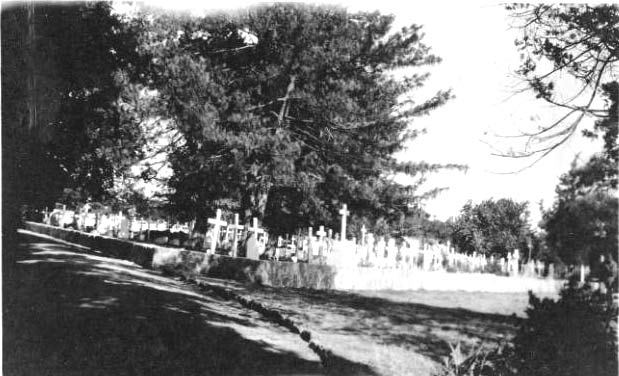
Haidar Pasha Cemetery in 1923
The CWGC cemetery at Haidar Pasha holds the following graves
Private Flynn's death was by shooting for murder. His is the last entry in the list in Oram and PutKowski's ' Death Sentences passed by military courts of the British Army'. National Archives ref ADM 1, 116, 137, 156, 167, AIR 18, WO 711029, 93/49. He is buried in Haidar Pasha Military Cemetery in a suburb of Istanbul between Scutari (Uskudar) and Kadikoy on the Asiatic side of the Bosphorous.WO 71/1029 refers, according to its index entry, to the court martial of R Flynn and F Hardy for murder, but does not say if it is the same crime - in any event Hardy does not appear on the CWGC index.
On the 17th of November 1920, they left occupied Turkey for Multan in India.